New: FusePoint Cards updates — styling, audiences, drag & drop. Learn more.

Back

FusePoint Calendar Documentation

Type: webpart

Overview

The FusePoint Calendar web part provides a dynamic and visually appealing way to display events from SharePoint calendar lists.
It integrates with both classic and modern SharePoint lists (template ID 100), with support for overlays from multiple sources including shared mailbox calendars.

This web part is ideal for organizations looking to have a centralized, customizable, and interactive calendar view on their SharePoint sites.


Features

  • Multiple Calendar Overlays
    Add one or more calendars (SharePoint lists, shared mailbox calendars, or Microsoft 365 group calendars) and view them together in a single calendar.

  • Group Calendar Support (NEW)
    Users can now add a Microsoft 365 Group Calendar as a calendar source. Select the "Group Calendar" type in the Manage Calendars panel, then pick any group you belong to from the Name dropdown. Only members of the group will see its events, preserving existing group privacy.

  • Flexible Calendar Source Options
    Configure calendars using the Manage Calendars panel, with fields for Type, Name, Display Name, Category, Color, and Text Color.

  • Calendar & Category Filtering
    Users can filter events by categories or calendars.
    The “View by category” option is only shown when multiple calendars are selected.

  • List View Mode
    In addition to the standard calendar grid, admins can display events in list view.

    • Orientation: Choose Horizontal or Vertical layout.
    • Filter Criteria: Display upcoming events, past events, or current month events.
    • Number of Items: Limit how many events are shown (default: 3, null = unlimited).
    • Styling: Events use the primary theme color as the background with auto-adjusted text color for readability.
    • Shared Calendar Events: Unlike OOB SharePoint list views, FusePoint’s list view can also pull events from shared mailbox calendars.
  • Customizable Colors
    Assign each calendar a unique hex color code for event background, plus a text color option.

  • Modern Web Technologies
    Built on FullCalendar for a responsive, modern UI.

  • Style Customization
    Add custom CSS for a tailored calendar look and feel.

  • Event Details
    Click on any event to view details in a popup.

  • Recurrent Events
    Support for displaying recurrent events.

  • Error Handling for Non-Calendars
    When selecting a list without Start Time and End Time columns, the following error appears:
    “The selected list is not a calendar. Missing event start and end date.”

  • Performance Considerations
    Optimized to handle large datasets and recurrent events.


How to Use

Adding the Web Part

  1. Navigate to your SharePoint page and enter edit mode
  2. Click “Add a Web Part” and search for FusePoint Calendar
  3. Select the web part to add it to your page

Configuring Multiple Calendars

Click “Manage Calendars” to open the panel.

Each row defines a calendar source with the following fields:

  • Type (required)

    • SP List → A SharePoint calendar or modern list configured as a calendar
    • Shared Mailbox Calendar → A shared Exchange/Outlook mailbox calendar
    • Group Calendar → A Microsoft 365 group calendar; only group members can see the events
  • Name (required) – Dropdown or searchable field to select the calendar source

  • Display Name (required) – Label shown in the Select calendars panel

  • Category – For SP Lists only. Options: “All” or specific event category

  • Color – Hex color for event background (e.g., #003C71, #FF5733)

  • Text Color – Text color (white or black)

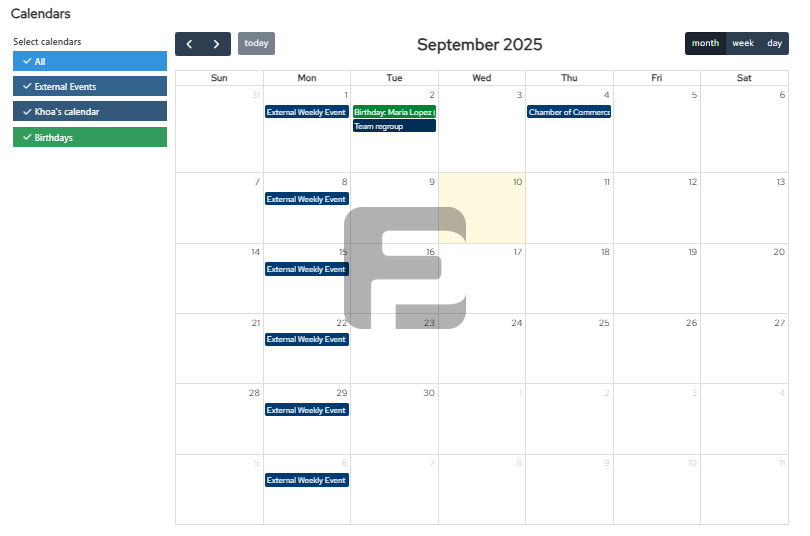
Calendars appear in the Select calendars panel on the left of the web part, where users can toggle visibility.
If only one calendar is selected, the “View by category” option is hidden.
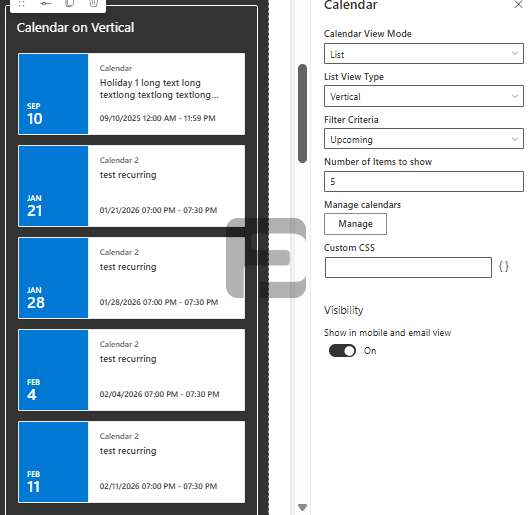

List View Mode

  • In the property pane, set Calendar View Mode to List
  • Choose List View Type: Horizontal or Vertical.
  • Select Filter Criteria: Upcoming Events, Past Events, or Current Month.
  • Define Number of Items to Show (default = 3, null = unlimited).
  • Save and republish to display events in list format.
List View Vertical

Group Calendar (NEW)

You can now overlay events from a Microsoft 365 Group Calendar alongside your existing SharePoint and shared mailbox calendars.

How to Add a Group Calendar

  1. Open the web part property pane and click Manage Calendars.
  2. Add a new row and set Type to Group Calendar.
  3. In the Name dropdown, select the group you want to display. The dropdown lists all Microsoft 365 groups you are a member of.
  4. Set a Display Name, Color, and Text Color as usual.
  5. Save and republish the page.

Privacy note: Events are only visible to users who are members of that group. Non-members will not see those events in the calendar, so existing group privacy is fully preserved.


Customization Options

  • Calendar Overlay: Overlay multiple SharePoint lists and shared mailbox calendars
  • List View Mode: Display events in horizontal or vertical list layouts
  • Color Customization: Assign colors via hex codes for each calendar
  • Text Color: White or black text option
  • CSS Styling: Apply custom styles to align with your branding
  • View Options: Choose between month, week, day, or list views
  • Filter Controls: Show categories and calendars as filters

Benefits

  • Centralized Event Management: All calendars in one place
  • Flexible Displays: Switch between calendar grid and list view
  • Improved Visualization: Color-coded events and category filters
  • Shared Mailbox Support: Pull events from Outlook shared calendars into SharePoint
  • Group Calendar Support: Overlay Microsoft 365 group calendars with member-only visibility
  • Enterprise Ready: Handles large datasets and recurring events

Conclusion

The FusePoint Calendar web part transforms SharePoint calendars into a modern, interactive scheduling tool.
With multi-calendar overlays, hex color coding, list view options, shared mailbox integration, and Microsoft 365 group calendar support, it provides a powerful and flexible solution for enterprise calendar management.


Timezone Behavior (Important Note)

The FusePoint Calendar web part always displays events based on the end-user’s local computer timezone.
  • Example: An event scheduled for Oct 23rd, 4–6 PM EST will show as Oct 23rd for users in EST, but as Oct 24th for users in certain APAC/Asia regions.
  • This ensures consistency with each viewer’s system time settings, but it may cause events to appear shifted by a day depending on the user’s timezone.

Timezone Behavior (Important Note)

The FusePoint Calendar web part always displays events based on the end-user’s local computer timezone.

  • Example: An event scheduled for Oct 23rd, 4–6 PM EST will show as Oct 23rd for users in EST, but as Oct 24th for users in certain APAC/Asia regions.
  • This ensures consistency with each viewer’s system time settings, but it may cause events to appear shifted by a day depending on the user’s timezone.

Fusepoint Calendar Example

Try FusePoint for Free!

No credit card required.

FusePoint

The perfect addition to your SharePoint environments.

$399

$0

USD for 30 Days
then $399/mo

  • 20+ new SPFx webparts
  • 6 SPFx extensions
  • Support
  • Documentation
Try FusePoint

Get your team started now.

Pricing